
Resource Market Insights – August 2026
THE CASE FOR FLOW-THROUGH: FOUR SIGNALS
The Commodity Signal: A Synchronized, Multi-Metal Re-Pricing
As we reach the end of August and enter the final four months of 2026, it is worth pausing to reflect on the remarkable performance of the metals markets over the past twelve months — and, more importantly, to consider the broader signal these prices are sending.
Gold has been the standout performer, rising from approximately $3,366/oz one year ago to a peak of $5,281/oz in February 2026 — a gain of more than 57% in just six months. More recently, gold underwent a healthy consolidation, retreating toward the $4,000/oz level before recovering to approximately $4,661/oz as of August 25, 2026. Gold’s resilience through this consolidation reinforces the view that the underlying structural bull market remains intact.
And the story extends well beyond gold. Year over year, copper is up over 43% to $14,362/t (1), lithium has surged 88% to $152,500/t (2), and uranium has gained approximately 24% to $89.55/lb (3). These are not isolated moves; they reflect a broader, multi-commodity re-pricing driven by structural demand from electrification, the energy transition, and growing geopolitical concerns around supply security.
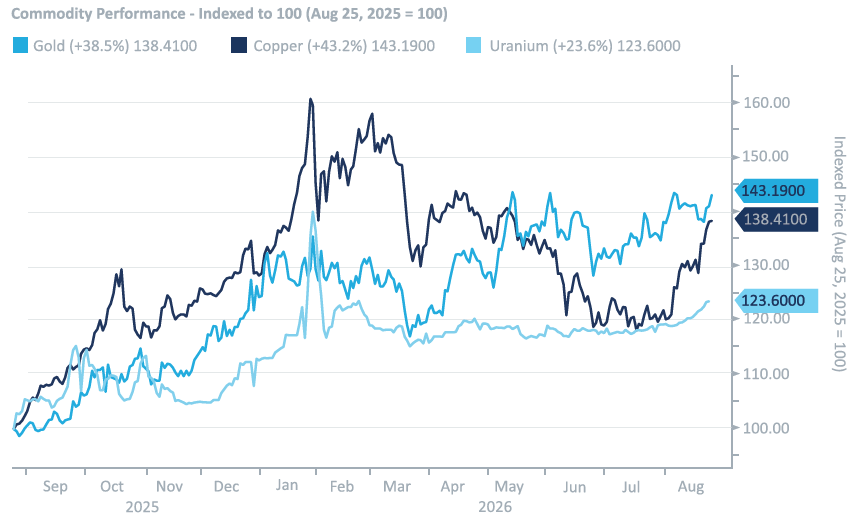
Source: Bloomberg. Prices indexed to 100 as of August 25, 2025. Gold (XAU Curncy) +38.5%, Copper (HGA Comdty) +43.2%, Uranium (UXA1 Comdty) +23.6%. Data as of August 25, 2026
Global demand for critical minerals used in clean energy, electrification, and technology is accelerating exploration and development spending, while geopolitical uncertainty and inflation concerns further enhance the attractiveness of resource investments as a strategic hedge.
The Catch-Up Signal: Junior Valuations Still Lagging Seniors
The past twelve months have been exceptional for mining equities across the board — but the more interesting story may be where the opportunity lies within the sector. To illustrate, we look at two widely followed ETFs that serve as proxies for the space: the VanEck Gold Miners ETF (GDX), which tracks senior producers, and the VanEck Junior Gold Miners ETF (GDXJ), which tracks smaller, earlier-stage companies. Senior miners (GDX) have returned +75.9% since August 2025, a remarkable performance by any measure. Junior miners (GDXJ) have matched and at times exceeded that pace, peaking at over +110% in February 2026 as speculative capital flooded into smaller, higher-beta names.
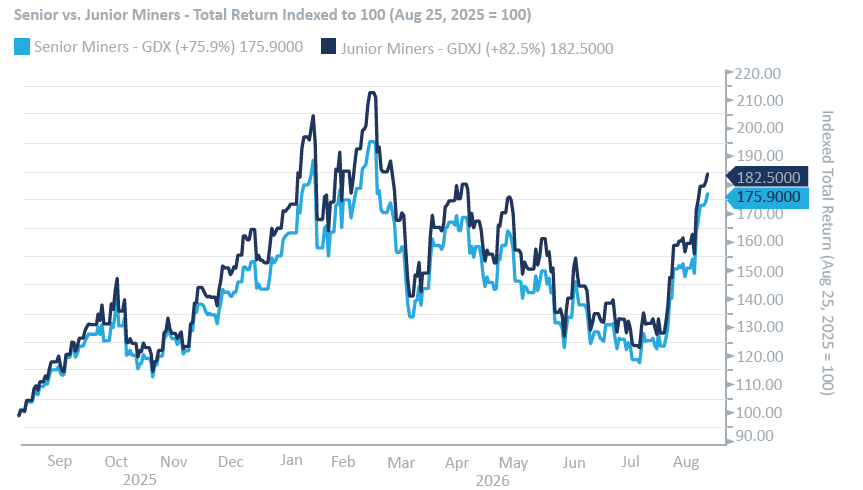
Source: Bloomberg. Total return indexed to 100 as of August 25, 2025. GDX (VanEck Gold Miners ETF) +75.9%, GDXJ (VanEck Junior Gold Miners ETF) +82.5%. Data as of August 25, 2026
But juniors sold off more sharply during the subsequent consolidation. As gold retreated from its February peak of $5,281/oz toward the $4,000/oz level, junior equities bore the brunt — reflecting their higher risk profile, lower liquidity, and greater sensitivity to sentiment shifts. Seniors, with their stronger balance sheets and cash flow generation, proved more resilient.
The result is a gap that has not yet fully closed. Despite recovering meaningfully, junior miners have not recaptured their February highs relative to their senior counterparts. That gap is the opportunity. Historically, juniors can lag in the early stages of a commodity bull market and then accelerate as capital flows down the risk curve — that rotation appears to be underway, but it is not complete.
Flow-through shares offer advisors a tax-advantaged entry point into this potential catch-up trade. The federal deduction materially reduces the cost of entry, and the underlying assets — junior explorers with active drill programs and development-ready projects — are precisely the names positioned to benefit most as the cycle matures.
The M&A Signal: Majors Are Buying Juniors
If commodity prices and valuations alone are not enough to illustrate the opportunity, consider what the world’s largest mining companies are doing with their balance sheets. The year 2026 has produced a remarkable wave of major-into-junior acquisitions — a clear signal that sophisticated, well-resourced buyers believe current valuations still understate the value of what lies in the ground.
The deals speak for themselves. Earlier this year, Equinox Gold acquired Orla Mining in a $5.1 billion transaction, and Eldorado Gold absorbed Foran Mining for $3.8 billion, creating a gold-copper giant. China’s Zijin Mining acquired Allied Gold for C$5.5 billion in January. Rio Tinto boosted its stake in Nemaska Lithium to a majority position, and Coeur Mining’s acquisition of New Gold received court approval in British Columbia. The pace and scale of consolidation is accelerating.
Perhaps the most instructive example came just this week. Agnico Eagle — one of the world’s premier gold producers — announced a C$57.2 million strategic investment in junior Radisson Mining, paying a 19% premium to Radisson’s average share price over the prior 20 trading days. In other words, Agnico was willing to pay significantly above the prevailing market price to secure its position. The market responded immediately: Radisson shares surged over 25% on heavy volume in a single session.
This is precisely the dynamic that makes the junior exploration sector compelling for flow-through investors, a major paying a meaningful premium to gain exposure to a junior explorer before the broader market has fully priced in the asset’s potential. The pattern is consistent with what happens at this stage of a commodity cycle. When prices reach structurally elevated levels, and organic reserve replacement becomes increasingly difficult, majors turn to acquisition. Junior explorers — the companies that flow-through financing helps fund, are among the potential beneficiaries of this consolidation cycle. Investing in them today, at a tax-advantaged cost of entry, means being on the right side of that dynamic before the next deal is announced.
The Policy Signal: Government Is Backing This Trade
One of the most compelling — and underappreciated — arguments for investing in junior mining flow-through shares right now is the degree to which government policy, at both the federal and provincial levels, has aligned behind the sector. This is not passive support. It is active, large-scale capital deployment designed to accelerate Canadian resource development at a moment of acute global demand for critical minerals.
Start with the tax structure itself. Canada’s flow-through share system allows qualifying exploration companies to renounce eligible exploration expenditures to investors, who can generally claim the associated deductions against taxable income. Two federal credits are currently available — and both have been extended through March 31, 2027:
- The Mineral Exploration Tax Credit (METC) provides a 15% non-refundable federal tax credit on qualifying Canadian exploration expenditures.
- The Critical Mineral Exploration Tax Credit (CMETC) provides a 30% non-refundable federal tax credit for exploration targeting specified critical minerals — copper, nickel, lithium, cobalt, uranium, and others.
Critically, the 2025 federal budget expanded the list of minerals eligible for the CMETC to include bismuth, cesium, chromium, fluorspar, germanium, indium, manganese, molybdenum, niobium, tantalum, tin, and tungsten — broadening the universe of qualifying investments significantly.
These are not marginal incentives. For a high-income investor, the combination of the full exploration deduction plus the METC or CMETC can reduce the effective cost of a flow-through investment by 60% or more, depending on the investor’s marginal tax rate and province of residence. Flow-through financing has historically accounted for a significant share of funds raised on Canadian stock exchanges for mineral exploration — a testament to how central this structure is to the sector’s funding model.
Beyond the tax framework, direct government investment is validating the sector at scale:
- The Canadian government committed C$500 million to expand the Red Chris copper-gold mine in British Columbia.
- Agnico Eagle announced a C$14 billion (~US$10.2 billion) commitment to Ontario gold assets through 2030 — described as one of the largest-ever private-sector investments in Ontario’s mining industry.
- The Canada Growth Fund deployed C$145 million in convertible notes to advance lithium production through Elevra Lithium’s Canadian subsidiary.
- Denison Mines reached a final investment decision on the Phoenix uranium mine in Saskatchewan — expected to be the first new large-scale Canadian uranium mine in over two decades.
- The US Department of Defense is actively soliciting investment in domestic critical minerals supply chains — indium, manganese, magnesium, and titanium — with Canada positioned as the most natural and proximate supplier.
The message from both Ottawa and Washington is increasingly clear: critical minerals are a strategic priority, and the capital — public and private — is following. For advisors looking to position clients in an asset class with both a structural growth story and a government-backed tax advantage, the window is open. But it is not permanent. The METC and CMETC expire on March 31, 2027.
Beneath the commodity price moves, the M&A wave, and the government commitments lies a single, unavoidable reality: the world is running short on the metals it needs most. Major producers do not have infinite reserves — and they cannot wait until existing resources are depleted before acting. The economics are simple: by the time a discovery becomes a producing mine, a decade or more may have passed. That means the exploration work being funded today is the production of tomorrow. Junior explorers are not a speculative sideshow; they are an essential part of the supply chain.
The confluence of factors we have outlined is rare. Commodity prices are at structurally elevated levels. Junior equities have not yet fully recaptured their highs relative to seniors. Government tax credits — the METC and CMETC — remain in place through March 31, 2027, offering high-income investors a cost of entry that is materially lower than the market price. Active M&A is rewarding junior shareholders with meaningful premiums. And the supply deficit driving all of this is not going away; it is deepening.
Flow-through shares sit at the intersection of all of these forces. For advisors with clients in higher tax brackets seeking exposure to one of the most compelling resource cycles in a generation, the case has rarely been stronger. The tax deadline is finite. The commodity cycle is not waiting. The time to act is now.
Glenn G. Drodge, CFA
Senior Portfolio Manager
(1),(2),(3) Source: Bloomberg